
Article-At-A-Glance: HVAC Business Review Tips
- 87% of consumers read online reviews for local businesses, and HVAC companies with 4+ star ratings see up to 20% more conversions — making your review strategy a direct revenue driver.
- Google Business Profile is the single most important review platform for HVAC contractors, directly influencing local search rankings and Google Maps visibility.
- The best time to ask for a review is immediately after a successful job — timing and simplicity are the two biggest factors in whether a customer actually leaves feedback.
- Responding to negative reviews the right way can actually rebuild trust faster than having no bad reviews at all — there’s a simple formula for this covered below.
- Automating your review request process through HVAC field service software can dramatically increase review volume without adding extra work for your team.
Your HVAC business could be doing everything right on the job — and still losing customers to a competitor with better online reviews.
In a service industry built on trust, online reviews are the new word of mouth. Before a homeowner lets anyone near their heating or cooling system, they check ratings. According to BrightLocal, 87% of consumers read online reviews for local businesses, and that number is even higher for home service industries like HVAC. A strong review profile doesn’t just build credibility — it directly feeds your pipeline. Businesses with consistent, high-quality reviews rank higher in local search, get more calls, and close more jobs.
For HVAC contractors looking to sharpen their online reputation strategy, industry-focused tools and resources can make the process significantly more manageable, especially when you’re running a busy operation with technicians in the field every day.
Why Online Reviews Matter More Than Word of Mouth
Word of mouth used to mean a neighbor recommending your company over the fence. Today, that conversation happens on Google, Facebook, and Angi — and it reaches hundreds of potential customers instead of one. Understanding the role and impact of customer service reviews is crucial for businesses aiming to harness this digital word of mouth effectively.
The Numbers That Matter:
“68% of consumers trust online reviews as much as personal recommendations.” — Nielsen
“87% of consumers read online reviews for local businesses in 2023.” — BrightLocal
“Businesses with 4+ star ratings see up to 20% more conversions.” — ReviewTrackers
“Top-rated HVAC firms report 15–25% higher lead generation compared to lower-rated competitors.”
The trust factor is especially critical in the HVAC industry. You’re asking homeowners to let a technician into their home to work on systems that control their family’s comfort and safety. That’s not a casual purchase — it’s a trust decision. A steady stream of authentic five-star reviews answers the unspoken question every prospect is asking: “Can I trust these people?” To ensure authenticity, learn how to identify genuine HVAC service reviews.
76% of Consumers Avoid Businesses With Negative Reviews
A single unaddressed one-star review can do serious damage. Studies consistently show that the majority of consumers will move on to a competitor after reading negative feedback that hasn’t been responded to. It’s not just about having good reviews — it’s about actively managing your reputation so that no review, positive or negative, goes unacknowledged.
4-Star Ratings Drive Up to 20% More Conversions
For HVAC contractors, a 20% bump in conversions isn’t a minor marketing win — it’s the difference between a slow month and a fully booked schedule. Research from ReviewTrackers confirms that businesses maintaining a 4-star rating or above see measurably higher conversion rates from profile views to actual service bookings. The goal isn’t perfection; it’s consistency and volume.
Even a business with occasional three-star reviews can outperform a competitor if it has significantly more total reviews and a higher average. Quantity and recency both matter to both consumers and search algorithms.
Reviews Directly Boost Your Local SEO Rankings
Google uses review signals as a ranking factor in local search results. This means a business with 50 recent, authentic reviews will often outrank a competitor with a more polished website but fewer reviews — even if that competitor has been in business longer. Every new review is essentially a fresh signal to Google that your business is active, legitimate, and trusted by real customers.
This creates a compounding effect: more reviews lead to better rankings, better rankings lead to more visibility, and more visibility leads to more customers — who then leave more reviews.
The Best Review Sites for HVAC Companies
Not all review platforms are created equal for HVAC businesses. Your strategy should prioritize the platforms that homeowners actually use when searching for heating and cooling services in their area.
Google Business Profile: The Most Important Platform
Google Business Profile (formerly Google My Business) is non-negotiable. It powers the local knowledge panel that appears in search results and integrates directly with Google Maps — the two places most homeowners look first when they need an HVAC technician fast. A fully optimized profile with a strong review count puts you in the coveted “Local Pack” — the top three results that appear before any organic listings. For HVAC businesses, understanding the importance and impact of customer reviews can greatly enhance visibility and trust in this competitive field.
Facebook Reviews: Reaching Homeowners Where They Already Are
Facebook remains one of the most effective review platforms for home service businesses because of how its social sharing works. When a satisfied customer leaves a review on your Facebook business page, their friends and neighbors can see it in their feed. For HVAC companies targeting specific neighborhoods or communities, this organic social proof is incredibly powerful and costs nothing to generate.
Angi and HomeAdvisor: Industry-Specific Review Power
Platforms like Angi (formerly Angie’s List) and HomeAdvisor are specifically designed for home service businesses, and the homeowners using them are already in buying mode. Reviews on these platforms carry extra weight because the audience is hyper-targeted — they’re not casual browsers, they’re people actively looking to hire an HVAC contractor right now. Maintaining strong ratings across both platforms expands your reach beyond Google and captures leads at the bottom of the decision funnel. For more insights, check out these HVAC customer service reviews and their role in impacting business success.
How to Ask Customers for HVAC Reviews Without Being Awkward
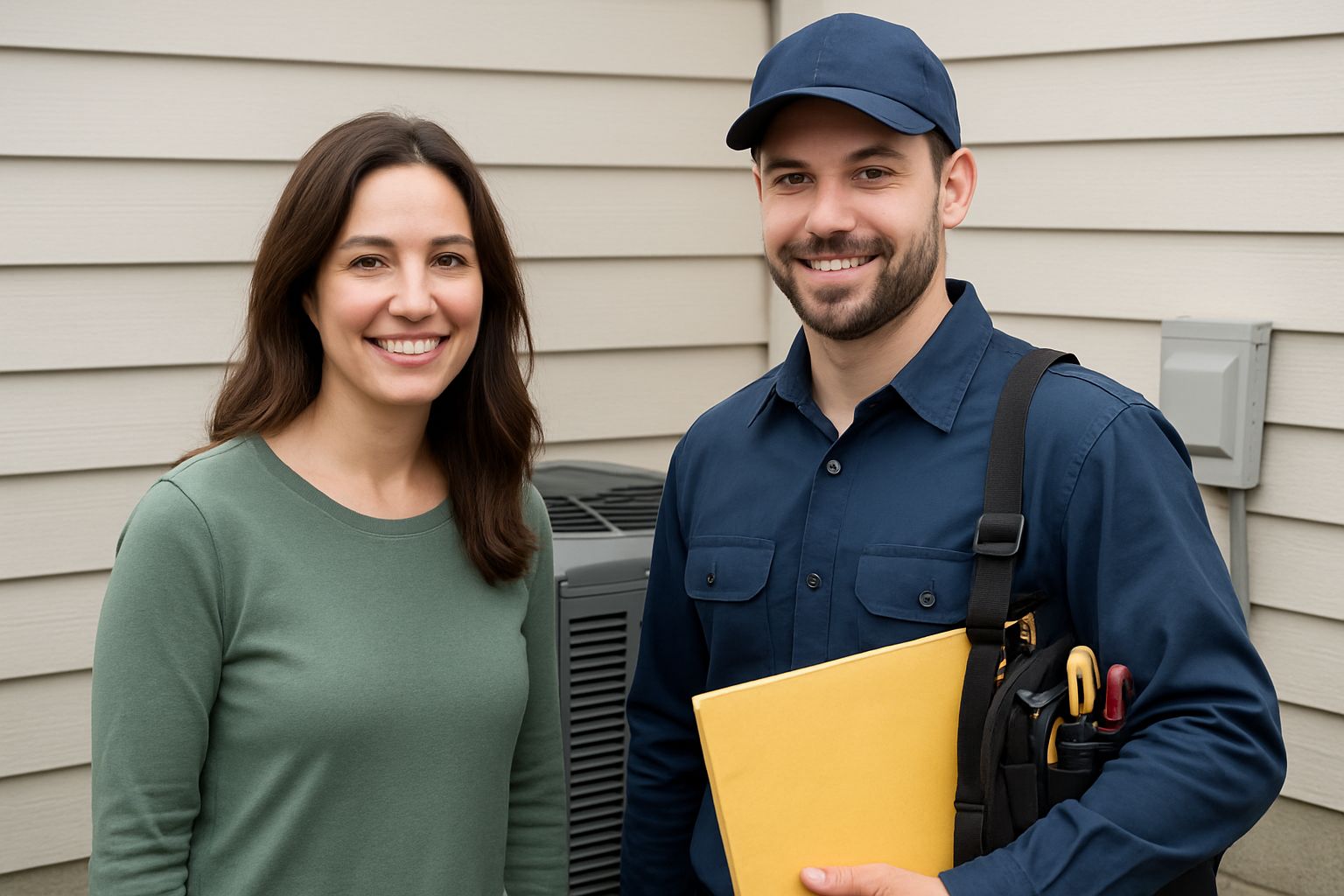
The biggest reason HVAC companies don’t have enough reviews isn’t that their customers are unhappy — it’s that no one asked. Most satisfied customers simply move on with their day after a good service experience. They’re not thinking about leaving a review unless something prompts them to do so.
The good news is that asking doesn’t have to feel pushy or uncomfortable. When done correctly, it feels like a natural extension of great customer service — and most people are genuinely happy to help a business they liked working with. For more insights, you can explore the importance and impact of timeliness in customer reviews.
1. Ask In Person Right After the Job Is Done
The single most effective moment to ask for a review is the minute the job wraps up — when your technician is still standing in the customer’s home and the relief of a working AC or heater is fresh. A simple, confident statement works better than a question: “We really appreciate your business. If you’re happy with the work today, a quick Google review would mean a lot to us.” That’s it. No pressure, no lengthy explanation — just a direct, genuine ask.
2. Send a Follow-Up Email With a Direct Review Link
Not every customer will pull out their phone on the spot, and that’s fine. A follow-up email sent within two to four hours of job completion captures the people who needed a small nudge. The key is making it effortless — include a direct clickable link to your Google Business Profile review page so the customer doesn’t have to search for you.
- Keep the email short — three to four sentences maximum
- Use the customer’s first name in the subject line to increase open rates
- Include your direct Google review link as a prominent button, not buried text
- Send from a real person’s name (e.g., Mike from ABC Heating & Cooling), not a generic company address
- Time it within two to four hours post-service while the experience is still top of mind
If you don’t hear back after the first email, a single follow-up two days later is completely acceptable. Beyond that, let it go — over-messaging damages the customer relationship you just built.
SMS text messages are also worth testing here. Many HVAC customers, especially in the 35–55 age demographic, respond faster to a text with a direct link than they do to an email. Tools like Podium and Birdeye allow you to automate these text-based review requests directly from your job management system.
3. Add a Google Review Badge to Your HVAC Website
A Google review badge is a small embedded widget that displays your current star rating and total review count directly on your website. It serves two purposes: it reinforces trust for new visitors evaluating your business, and it gives existing customers who visit your site a frictionless path to leave their own review. Placing the badge on your homepage, contact page, and service confirmation pages maximizes visibility without feeling intrusive. For more insights, consider exploring the importance of timely customer reviews for your HVAC business.
4. Use HVAC Field Service Software to Automate Review Requests
Manual follow-up works when you have five jobs a week. When you’re running a full team with 20 to 30 daily service calls, automation is the only scalable solution. HVAC field service software platforms like Workiz, ServiceTitan, and Housecall Pro allow you to automatically trigger review request emails or texts the moment a job is marked complete in the system — no manual effort required from your office staff or technicians. Consistent, automated outreach is how busy HVAC companies go from 40 reviews to 400 reviews in a single season. For more insights, explore HVAC service review improvement analysis.
How to Incentivize Your Technicians to Earn 5-Star Reviews
Your technicians are the face of your HVAC business. Every interaction they have with a homeowner is either building toward a five-star review or quietly killing the chance of one. Creating a culture where your team is genuinely motivated to deliver review-worthy service is one of the highest-leverage investments you can make in your reputation strategy.
Reward Systems That Actually Motivate Field Technicians
Simple recognition programs tied to review mentions consistently outperform generic bonuses. When a customer specifically names a technician in a five-star review, that technician should receive immediate, visible recognition — whether it’s a cash bonus, a gift card, a preferred scheduling perk, or public acknowledgment in a team group chat. The specificity matters: technicians who are named in positive reviews feel directly connected to the company’s success, which reinforces the behaviors that earned the review in the first place.
How Exceptional On-Site Service Leads to Unprompted Reviews
Some of the best reviews HVAC companies receive are ones nobody asked for — they happen because a technician did something that genuinely impressed the customer. These unprompted reviews are typically longer, more detailed, and more persuasive to potential customers than the brief ones collected through automated follow-ups. To understand the importance of authentic feedback, HVAC businesses can gain insights into how genuine reviews impact their reputation.
The behaviors that trigger unprompted reviews are usually small, but they’re consistent. Technicians who wear shoe covers, explain what they’re doing in plain language, clean up thoroughly after the job, and arrive on time create an experience that feels noticeably different from the average service call.
Training your team on these soft skills isn’t a luxury — it’s a review generation strategy. A technician who communicates clearly and treats a customer’s home with respect is far more likely to be named in a glowing review than one who simply fixed the problem and left.
Consider building a short “service excellence” checklist into your technician onboarding and regular training sessions. The behaviors that earn five-star reviews are teachable, and when they become habit, your review count reflects it.
- Always introduce yourself by name when arriving at the job
- Put on shoe covers before entering the home — every single time
- Explain the issue and the fix in simple, jargon-free language
- Show the customer the completed work and confirm they’re satisfied before leaving
- Leave the work area cleaner than you found it
- Ask if they have any other questions before heading out
How to Respond to Negative HVAC Reviews the Right Way
Negative reviews are not the end of the world — but ignoring them is. How you respond to criticism publicly tells potential customers far more about your business than the original complaint ever could. A calm, professional, solution-focused response to a one-star review can actually convert a skeptical prospect into a paying customer.
What Never to Say in a Response to a Bad Review
Never get defensive, argue with the facts presented, or make excuses in a public response. Avoid vague corporate language like “We strive for excellence” — it reads as dismissive and impersonal. Never mention other customers, violate privacy by referencing job details publicly, or offer refunds in the response itself. Most importantly, never respond when you’re frustrated — write your response, walk away for 30 minutes, and re-read it before hitting publish. For more tips on managing reviews, check out these helpful review tips for HVAC businesses.
A Simple Response Formula That Rebuilds Trust Fast
A reliable response structure follows four steps: acknowledge the customer’s frustration without admitting fault prematurely, apologize genuinely for the experience they had, take the conversation offline by providing a direct phone number or email for resolution, and follow through by actually resolving the issue. A response that follows this formula — written in under 100 words, in a calm and professional tone — demonstrates accountability and signals to every future reader that your company takes customer satisfaction seriously.
Common HVAC Review Mistakes That Cost You Customers
The most damaging review mistake HVAC companies make isn’t getting a bad review — it’s doing nothing at all. A stagnant review profile with no new feedback in six months signals to both Google and potential customers that your business may no longer be active or relevant. Review recency matters almost as much as review volume, and letting your profile go quiet is a slow leak in your lead pipeline.
The second most costly mistake is incentivizing reviews in ways that violate platform policies. Google explicitly prohibits offering discounts, free services, or any other reward in direct exchange for a review. Companies caught doing this risk having their entire review profile penalized or removed — wiping out months or years of reputation building overnight. The only safe and sustainable path is earning reviews through genuine service excellence and asking at the right moment.
Track Your Review Strategy Results With These Key Metrics

Running a review strategy without tracking results is like running a service call without diagnosing the system — you’re working blind. Once you have a consistent process for collecting and responding to reviews, you need a small set of metrics to tell you whether it’s actually working and where to improve.
Review Volume and Average Star Rating
These two numbers are your baseline. Track your total review count across Google, Facebook, and Angi on a monthly basis, and note the rate at which new reviews are coming in. A healthy HVAC company actively requesting reviews should be adding new feedback consistently — not in bursts followed by long quiet periods. For more insights on maintaining a steady flow of reviews, check out our business reviews tips.
Your average star rating should stay above 4.0 at all times. If it dips below that threshold, it’s not just a perception problem — it’s a conversion problem. ReviewTrackers data confirms that businesses below a 4-star average see measurable drops in click-through rates from search results, meaning fewer people are even reaching your website or calling your phone number. For more insights, check out these HVAC service quality metrics that matter most in reviews.
Response Rate and Speed
Google tracks whether and how quickly businesses respond to reviews, and it factors this into local ranking signals. Aim for a 100% response rate on all reviews — positive and negative — and target a response time of under 24 hours. Responding to positive reviews is just as important as addressing negative ones; a brief, genuine thank-you reply to a five-star review shows future readers that a real person is running this business and cares about their customers.
Set up Google Business Profile notifications so you’re alerted the moment a new review comes in. For larger operations with multiple technicians and high daily job volume, designate a specific team member — ideally someone in your office — as the review response owner so nothing slips through the cracks.
Your HVAC Reviews Are a Long-Term Revenue Engine
Every five-star review your business earns today is working for you 24 hours a day, seven days a week — building trust with homeowners who find you on Google at midnight when their furnace goes out, reassuring a family comparing three HVAC contractors before a major system replacement, and signaling to search algorithms that your business deserves top placement in local results. The compounding effect of a strong review profile is one of the most powerful and cost-effective growth levers available to any HVAC company, regardless of size.
Start with one action today: add a direct Google review link to your next job completion email. Build from there. The HVAC companies dominating local markets in their area didn’t get there by accident — they made reviews a non-negotiable part of their customer experience, and the results followed. Your satisfied customers are already out there. Give them a simple, frictionless way to tell your story for you.
Frequently Asked Questions
Below are the most common questions HVAC business owners ask when building or improving their online review strategy. These answers cut through the confusion and give you clear, actionable guidance.
How many Google reviews does an HVAC company need to rank in the local pack?
- There is no fixed number Google publicly confirms, but competitive analysis of local HVAC markets consistently shows patterns
- In smaller markets or suburban areas, 25 to 50 reviews with a 4.5+ average is often enough to appear in the Local Pack
- In mid-size cities, the top three Local Pack results typically have 75 to 150+ reviews
- In major metro areas, competitive HVAC companies often have 200 to 500+ reviews to hold a top position
- Review recency matters alongside volume — a company with 300 reviews but none in the last 90 days can be outranked by a competitor with 80 recent ones
The practical takeaway is this: research the top three HVAC companies currently ranking in your specific market right now, check their review counts, and use that as your near-term benchmark. You’re not competing nationally — you’re competing locally, and local benchmarks vary significantly. For more insights, explore strategies to build trust with authentic reviews in your local market.
Focus on consistent monthly growth rather than chasing a single number. A company adding 10 to 15 genuine reviews per month will outpace a competitor that collected 100 reviews in one push and then stopped, because Google weighs recency heavily in its local ranking algorithm.
Can HVAC companies offer discounts in exchange for reviews?
No — and the risk is significant enough that it’s not worth testing. Google’s review policies explicitly prohibit incentivizing reviews with discounts, free services, gift cards, or any other form of compensation. Businesses found in violation risk having their review profile suppressed, their reviews removed in bulk, or their Google Business Profile suspended entirely. The same restrictions apply to Yelp, Angi, and most other major platforms. The only compliant approach is to ask sincerely, make the process easy, and let the quality of your service do the rest.
How do I remove a fake or unfair negative review on Google?
You cannot remove a review simply because it’s negative or you disagree with it. However, if a review violates Google’s content policies — such as containing hate speech, being clearly posted by a competitor, or referring to a job you have no record of — you can flag it for removal directly through your Google Business Profile dashboard by clicking the three-dot menu next to the review and selecting “Report review.”
Google’s review removal process is slow and inconsistent, and there’s no guarantee a flagged review will be taken down. Your best response strategy while waiting is to reply publicly and professionally, acknowledge that you have no record of the customer or job described, and invite them to contact you directly to resolve any legitimate concern. This response protects your reputation with future readers even if the review stays up.
How often should I be checking my HVAC company’s online reviews?
Check your reviews at minimum once every 48 hours across all platforms. Enable real-time notifications through Google Business Profile, Facebook, and any other platforms you’re active on so you can respond quickly rather than on a fixed schedule. Response speed is a ranking signal, and customers who leave reviews — especially frustrated ones — notice when responses take days or weeks to appear. For more insights, explore the importance of responsiveness in business reviews.
What is the best time to ask a customer for an HVAC review?
The single best moment is immediately after the job is completed and the customer has confirmed they’re satisfied — while the technician is still on site. At that moment, the customer’s positive experience is at its peak and the emotional memory is freshest. A warm, confident verbal ask from the technician paired with a follow-up text or email within two to four hours of job completion creates two natural touchpoints without feeling aggressive.
Avoid asking for reviews before the job is done, during the payment collection process (which creates a transactional feel), or more than 48 hours after the service call when the experience has faded from memory. Timing your ask to the peak of the customer’s satisfaction is the single easiest way to increase your review conversion rate without changing anything else about your strategy.
For HVAC companies ready to take their reputation and customer management to the next level, exploring dedicated field service platforms that integrate review automation, job tracking, and customer communication into one system is a smart next step toward building a review profile that consistently drives growth.


Leave a Reply